
Walk into almost any professional sports facility and you’ll probably find a hyperbaric chamber somewhere in the building.
Athletes have used them for years, and the anecdotes are everywhere — faster bounce-back after games, less soreness, quicker return from injury. But when you actually look at the research, the picture is more nuanced than the highlight-reel version suggests.
At Core iV Therapy®, we think athletes deserve an honest answer, not a hyped one. Here’s what the evidence actually shows about hyperbaric oxygen therapy (HBOT) and athletic recovery.
The Research Is More Mixed Than the Headlines Suggest
An earlier 2021 meta-analysis looking at HBOT around exercise did not find significant overall improvements in athletic performance or post-exercise recovery. That’s worth sitting with, because it runs against the popular narrative.
More recent research tells a slightly different story. A 2026 systematic review and meta-analysis found that HBOT reduced post-recovery blood lactate in the studies analyzed — a marker researchers use to gauge how efficiently the body is clearing exercise byproducts. Separately, a 2025 meta-analysis reported improvement in recovery from exercise-induced muscle injury, although it did not find a clear effect on muscle soreness specifically.
So should every athlete expect HBOT to make them faster tomorrow? No. That’s not a claim the research supports, and it’s not how we position it.
A Better Frame: Recovery Environment, Not Magic Bullet
We’re much more interested in HBOT as one part of a broader recovery environment:
- Supporting recovery between training sessions
- Tissue oxygenation
- Injury-recovery protocols
- Repeated exposure built into a training calendar, not a one-off before competition
- Maintaining a high-performance body over a season, not just a single event
For serious athletes, recovery isn’t what happens when training stops. Recovery is part of training — and that framing matters more than chasing any single session’s effect.
Why We Use 1.3 ATA With Supplemental Oxygen
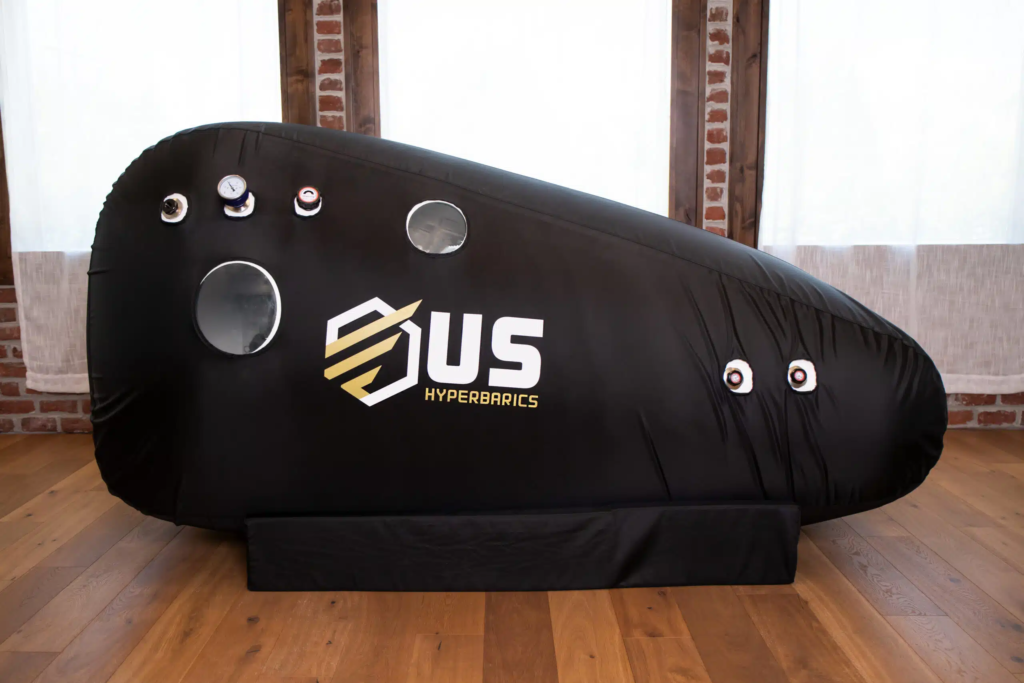
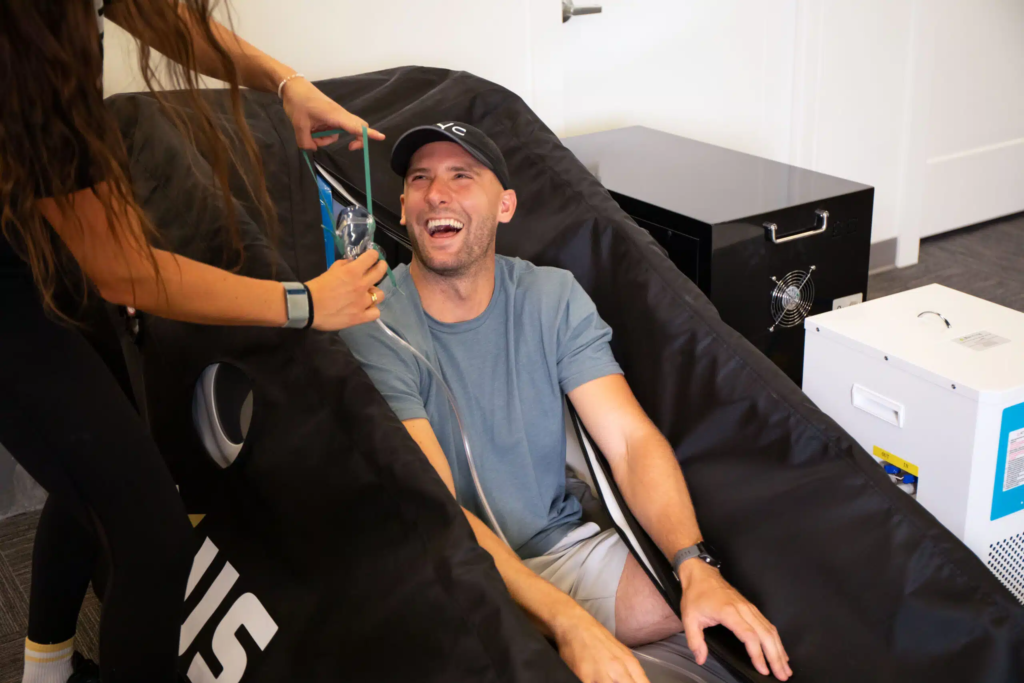
Our mild hyperbaric chamber operates at approximately 1.3 ATA, with supplemental oxygen delivery by mask when appropriate. That combination is designed for something athletes actually need: a protocol they can return to repeatedly throughout a training cycle, not an intense one-time exposure.
Many athletes pair HBOT with other recovery modalities — ozone therapy, IV hydration or PEMF — and typically use the hyperbaric session as the final step in that stack, once other interventions have had a chance to work.
What This Looks Like at Core iV
For athletes building HBOT into a recovery routine, we generally recommend:
- Sessions of roughly 60 minutes at therapeutic pressure
- A consistent, repeatable schedule tied to your training calendar
- Supplemental oxygen delivery by mask
- Realistic expectations — think steady recovery support, not a performance shortcut
If performance and recovery are a bigger part of your training life, take a look at our Athletic Performance programs — or, for elite and professional athletes, our Professional Athlete Concierge service.
Talk to Us About Your Training Goals
If you’re training seriously and wondering whether hyperbaric oxygen has a place in your recovery routine, schedule a consultation with Core iV Therapy®. We’ll look at your training load, your goals and where HBOT may or may not fit.
Core IV Therapy® is located at 108 Elden Street, Suite 15A, Herndon, VA 20170. Call 866-426-7348 or book online.
Quick Answers
Does hyperbaric oxygen therapy improve athletic performance?
The evidence is mixed. A 2021 meta-analysis found no significant overall improvement in performance or recovery, while a 2026 review found reduced post-exercise blood lactate. It’s best viewed as a possible recovery support, not a guaranteed performance booster.
Can HBOT help with exercise-induced muscle injury?
A 2025 meta-analysis reported improvement in recovery from exercise-induced muscle injury, though it did not find a clear effect specifically on muscle soreness.
How often should athletes use hyperbaric oxygen therapy?
We generally recommend a consistent, repeated schedule tied to a training calendar rather than a single session, since most of the supportive research involves repeated exposures over time.
What pressure does Core iV Therapy use for athletic recovery?
Our mild hyperbaric chamber operates at approximately 1.3 ATA with supplemental oxygen delivery by mask, designed for repeatable use throughout a training cycle.
References
Huang et al. 2021 – Athletic Performance & Recovery
Systematic review and meta-analysis examining HBOT around exercise.
2025 Systematic Review – Exercise-Induced Muscle Injury
Meta-analysis examining HBOT and recovery from exercise-induced muscle injury.
2026 Systematic Review & Meta-analysis – Athletic Recovery
Recent analysis examining HBOT, athletic recovery and post-exercise lactate.