
Think of your cells as millions of tiny offices, constantly sending each other messages. They don’t use email or texts — they use tiny biological envelopes called exosomes. And what researchers are learning about those messages is one of the most exciting areas in regenerative science today.
Here’s what exosomes may be able to do, in plain language — no science degree required.
What Exactly Is an Exosome?
An exosome is a tiny, membrane-bound particle released by cells. Picture a microscopic delivery envelope carrying cargo like proteins, lipids, and genetic signals (RNA) from one cell to another.
Exosomes aren’t stem cells, and they don’t turn into new tissue themselves. Think of it this way:
- Stem cell = the factory
- Exosome = one of the packages the factory sends out
Instead of becoming tissue, exosomes carry instructions — and it’s those instructions that have researchers so interested.
That factory-and-package comparison is about where exosomes come from — not about needing a factory nearby to work. Once released, an exosome is already packaged with everything it needs to deliver its message. That’s exactly why exosome therapy is administered on its own, without live stem cells: the messengers are effective in their own right, not simply a byproduct that needs stem cells present to do their job.
What Can Exosomes Possibly Do?
Because exosomes are essentially cellular messengers, researchers are exploring their role in a wide range of the body’s natural processes. Some of the most promising areas of interest include:
- Cell-to-cell communication — helping cells “talk” to each other more effectively
- Inflammatory signaling — influencing how the body manages inflammation-related pathways
- Tissue repair support — coordinating the signals involved in healing and recovery
- Angiogenesis — supporting the formation and remodeling of blood vessels
- Immune signaling — communication between cells involved in immune response
- Skin and tissue biology — including collagen-related and wound-healing research
- Neurological research — investigating potential roles in nerve and brain-related communication
- Musculoskeletal research — including interest in cartilage, tendon, and joint-related science
This is what makes exosomes such a different conversation from a typical vitamin or supplement. Instead of just adding another ingredient, researchers are studying the body’s own communication network — and asking whether it can be supported and enhanced.
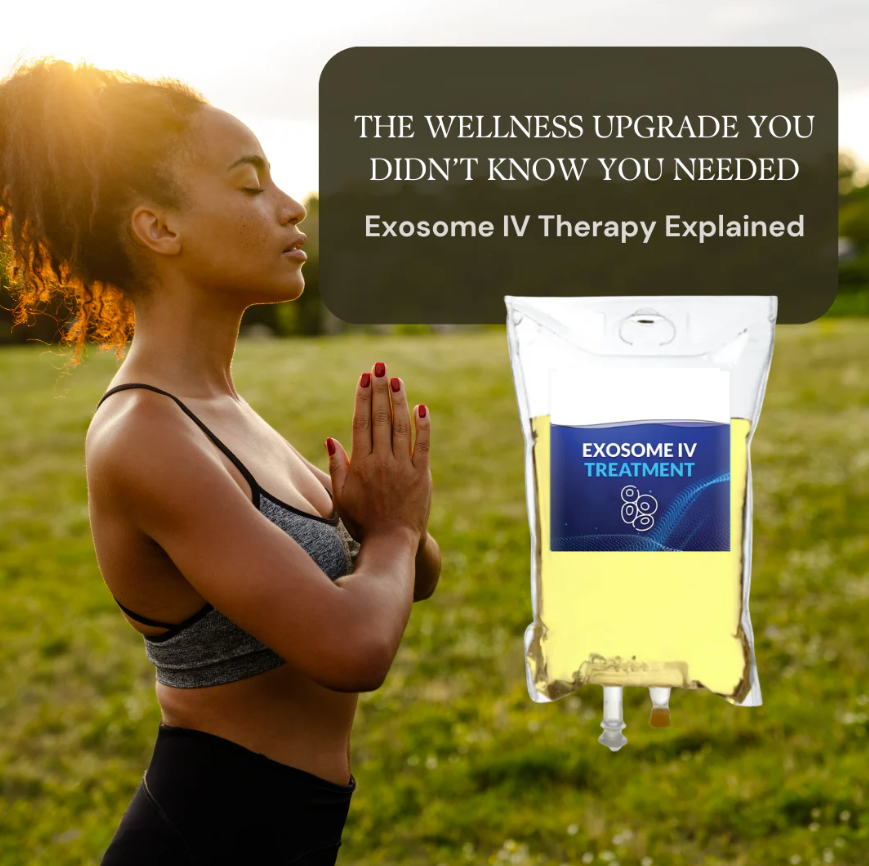
Why Core iV Therapy Chose an Umbilical-Cord-Derived Source
Not all exosome products are made the same way. At Core iV Therapy, our exosome product is derived from umbilical-cord-associated cells rather than adult bone-marrow cells.
Here’s our philosophy: a substance is only as good as the source it comes from. When exosomes are derived from an adult donor’s bone marrow, there’s no way to know that donor’s diet, environment, or lifestyle habits — factors that can influence the biological signals a cell releases. That’s part of why sourcing is one of the first questions we ask before deciding what we offer.
Umbilical-cord mesenchymal stromal cells come from perinatal tissue — a source researchers are especially interested in for its signaling profile and potential applications in tissue repair, inflammatory signaling, and regenerative science. We chose this source because we believe the science, sourcing, and manufacturing behind a product matter just as much as the word “exosome” on the label.
How Exosome Therapy Fits Into a Biohacking Routine
Exosomes are part of a bigger picture. In our Biohacking Series, we’ve covered how NAD+ supports cellular energy, how peptide therapy can act as a signaling tool, and how hyperbaric oxygen therapy changes the body’s oxygen exposure. Exosomes add a new layer to that conversation: cell-to-cell messaging.
We particularly love pairing exosome therapy with ozone therapy and hyperbaric oxygen therapy. Here’s the thinking behind it: exosomes are signals, and a signal is only as useful as the environment it lands in. Hyperbaric oxygen therapy increases the amount of oxygen available to your tissues, and ozone therapy is studied for its effects on circulation and the body’s response to oxidative stress. Pairing exosome therapy with these oxygen- and circulation-focused therapies is our way of supporting both halves of that equation — the message, and the environment the message is delivered into.
Many of our clients explore exosome therapy as one piece of a broader, personalized approach — find out more about why we stack therapies at Core iV.
Exosome Therapy: Quick Answers
What are exosomes?
Exosomes are tiny particles released by cells that carry proteins, lipids, and genetic signals to other cells — essentially a cellular messaging system.
Are exosomes the same as stem cells?
No. Stem cells are living cells; exosomes are the tiny messenger particles those cells release. Exosomes don’t become new tissue themselves.
Where does Core iV Therapy’s exosome product come from?
Our exosome/EV product is derived from umbilical-cord-associated cells, collected and processed from donated tissue — not from a baby’s own stem cells.
Is exosome therapy FDA-approved to treat a disease?
No exosome product is currently FDA-approved to treat a specific disease. Exosome science is a fast-growing, actively researched field, and we believe in being transparent about where the research stands while helping clients make informed decisions.
Is exosome therapy right for me?
It depends on your health history and goals. Our team can walk you through what we use, why we selected it, and how it may fit into your wellness routine.
Ready to Learn More?
If you’ve been hearing about exosomes and want to know whether they belong in your wellness routine, our team at Core iV Therapy is here to help. Call us at 866-426-7348 or visit us at 108 Elden Street, Suite 15A, Herndon, VA 20170 to book a consultation.
Related Articles
Continue exploring our Biohacking Series: